Thank you for contacting us for your implant identification needs.
While we have become quite effective at identifying implants here in the States, those placed outside the U.S. are much more difficult, with little to no resources available to identify them. For these reasons, we are not accepting consults for implants placed outside the U.S. at this time. We apologize for the inconvenience. Please review the following before starting your consult — you'll be asked to acknowledge each section.
Fees
Each consult covers one patient. Additional implants must be in that same patient — implants from a different patient require a separate consult.
You will be prompted to indicate how many implants you want identified. If you have multiple implants of the same type (they look the same), your consult is charged as a single implant. If there are multiple implants of different types in the same patient, there is a $50.00 fee per additional implant type.
- $225.00Identification of a single implant type
- $50.00Each additional implant of a different type, same patient
What information will we provide to you?
Determining the diameter of an implant by radiograph is difficult and unpredictable, so we do not offer this as part of the service. We will provide the implant manufacturer, along with information on where you may be able to obtain details for that implant. We encourage you to contact the implant manufacturer to verify those details with them.
Money-back guarantee
In the unlikely event that you have provided diagnostic images of the implant(s) in question and we are unable to identify them, a full refund will be processed. Please allow 5–7 days for processing.
If diagnostic images were not submitted initially and were later requested by our team but not provided, a $50 processing fee will be retained and the remainder will be refunded. Please allow 5–7 days for processing.
If an implant placed outside the U.S. is submitted for identification, we will not be able to service that request per the statement at the top of this page regarding consults we cannot accept. This will result in retaining a $50 processing fee, and the remainder will be refunded. Please allow 5–7 days for processing.
Response time
We aim to respond to your consultation within one week. Often, we respond in less than 24 hours. These responses come via email, so unfortunately we can't control whether aggressive filters prevent them from landing in your inbox. If you have not heard back from us in one week, please check your spam folder. If you still can't find it there, feel free to email us at consult@whatimplantisthat.com for an update.
For particularly challenging implants, we will use our many colleagues and implant company contacts to confirm our suspicions prior to sending you our answer. Oftentimes this is the reason these can take longer than a week.
Avoiding delays
The most common causes of delay are non-diagnostic radiographs and insufficient information. Please note the following:
- Please do not submit photos of computer screens.
- They are simply not diagnostic enough for implant identification. A photo of a screen will only delay your consultation, because we will have to contact you to request the actual image file exported from your software.
- Please do not submit CBCTs or images from CBCTs.
- They are not diagnostic for implant identification.
- File types and extensions matter.
- Only JPG, PNG or WEBP image files can be uploaded. We cannot open images exported from practice software as .DEX or .PSD — please export them correctly.
- Implant orientation in the X-ray matters.
- Think of the implant like a tooth and get the film as parallel to it as possible, like taking a bitewing. We need to see the implant in its entirety. The apex is one of the most important areas for identification, and is too often forgotten.
- Specifics matter.
- Be specific about which implant you want identified. Where we get snagged is when there is more than one implant and no reference to which tooth number you mean.
- Approximate time frame matters.
- Even if you are within a few years, give us an approximate year the implant was placed. Sometimes this is the tie breaker.
- A good email address matters.
- This is the most important thing after good images. Please give us an email that is checked often, by the person who submitted the consult — not a generic office inbox where our replies get mistaken for spam.
Radiographic suggestions
To give us the best chance of helping you, please consider the following.
- 1.Make your radiograph as perpendicular to the long axis of the implant as you can. This helps us see thread type, grooves, and other detail.
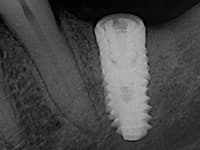
Not perpendicular — hard to see the thread type 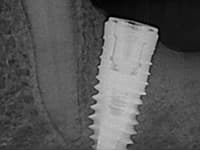
Thread type is much clearer (but the apex is cut off) - 2.Include at least one good-quality periapical radiograph showing both the coronal and apical portions. We often receive radiographs with the apex cut off.
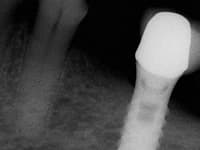
Cannot see whether the apex has holes, grooves, or its shape 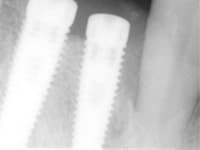
Overexposed, making detail difficult to see - 3.Useful adjuncts: bitewing radiographs, clinical photos of the implant platform, the healing abutment, and the driver used.
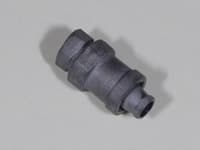
This impression transfer helped us find an obscure implant from Spain 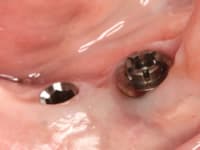
Sometimes a clinical photo alone identifies the implant - 4.It is often very useful to know where and when the implant was placed.
0 of 6 sections acknowledged
To continue with your consult, please acknowledge each section above.